Hansie Louw

Author, Coach, Entrepreneur

  • Home
    • Privacy Policy
  • Blog
  • Contact
  • About

Powered by Genesis

The Carte Blanche Law threatening the democracy in South Africa

May 8, 2020 by Hansie Louw Leave a Comment

Carte Blanche means literally “a free hand” or “total freedom”. It is interesting that the term “carte blanche” originates from French where it is understood as “white (or blank paper)” – the military term for surrender. It is ironic that this is exactly what this law allows – the military could get free reign, but if we look at this carefully then it is not what it allows.

There is a law in South Africa that allows the government and armed forces “a free hand”.

This law is now used as basis to fight COVID-19 and the application reveals the dangers in this legislation.


French military personnel try to control supporters who are asking them to disarm fighting gangs, near the airport in Bangui December 23, 2013.

Disaster Management Act of 2002

The purpose of this act is to coordinate the efforts of state, provinces or municipalities to react to a disaster or the prospects of a disaster. A state of Disaster may be declared under this act without approval or oversight from Parliament or the Judiciary. Under disasters one would normally think floods, earthquakes, fires and drought or similar threats. Many of the regulations were probably written against the backdrop of that thinking and not so much dealing with the threat of a virus, although of course that is included in the act. It is therefore perfectly logical that you would not allow a person to travel by vehicle through an area that is engulfed in flames. It is a disaster and it is dangerous. When it is a virus that is causing this disaster, it clearly is more difficult to indicate where you can travel or where not. More on this aspect (freedom of movement) later.

There is a difference between a State of Emergency and a State of Disaster. A State of Emergency Act 64 of 1997 requires approval from Parliament, but it essentially cancels about all basic rights of citizens of the country. All of these possible events under a State of Emergency is clearly described in the Constitution of the Republic of South Africa. One of the matters that it prescribes is what should happen if a person is arrested and what the relevant days are within which certain actions should be fullfilled. This will give the citizen still a certain amount of security. The Constitution clearly refers to the State of Emergency. We know that all acts of parliament are subservient to the Constitution and the fact that the Constitution clearly refers to the State of Emergency strenthens that perception. It refers to the Constitution and the fact that a competent court may declare a State of Emergency nul and void.

Section 37 of the Constitution deals with the State of Emergency:

(3) Any competent court may decide on the validity of—
(a) a declaration of a state of emergency;
(b) any extension of a declaration of a state of emergency; or
(c) any legislation enacted, or other action taken, in consequence of a declaration
of a state of emergency.

The same is not true of the Disaster Management Act. It is not referred to or mentioned in the Constitution. You could argue that this act came into operation long after the Constitution was adopted (2002 vs 1995) and that is the reason for that. The act containing the Constitution has been amended several times after this, several years past 2002 with the latest in 2016. There has been enough time to include the DMA (Disaster Management Act) in the Constitution. It is not mentioned there at all.

Why is the DMA not mentioned in the Constitution?

I believe that this was on oversight from Parliament. The existing other legislation should be enough (or so the parliamentarians thought) to counter the DMA. It could also be that the current actions from Government during the Covid-19 crisis stems from authority that is not in the DMA but in the State of Emergency Act. The DMA does allow regulations to be issued by different departments/organs of state to deal with the particular issue at hand. It was probably never contemplated that these regulations will be what has transpired. Each organ of state had to draw up a Disaster Management Plan for their area of responsibility. One would think that some of these aspects would be indicated there, but it is not. As a matter of interest, the availability of alcohol for selling or trading is indicated in the DMA as something that could be stopped, but not the selling of cigarettes.

On the other hand – if this legislation is part of a clever plan and has been designed to stand separate from the Constitution (although it should not), then it will give the Government carte blanche, a free hand to do whatever they want to do. This is almost unthinkable, but not improbable.

The unthinkable

The strategy for an overthrow of government could be as follows:

a. create a law that may allow exercise of powers not contained in the laws of the country

b. await an opportunity to enact that law

c. create enough hardship (like food shortage) to lead to open revolt by citizens (incite this revolt internally)

d. promulgate a state of emergency

e. silence all opposition

f. take over control of the army

g. remove executive (including State President) and dissolve parliament

h. redistribute assets

i. impose martial law

This would be unthinkable, but it is not impossible.  In South Africa we are now in stage C where there is food supply uncertainty. Open revolt is not there yet.

man with his food parcel
one of the blessed ones to receive a food parcel

To confirm my perception: I do not think for a minute that this is the planning of government, but I do not exclude this “unthinkable” situation that may be planned by certain elements.

Should the unthinkable happen in South Africa, most of the citizens will pay dearly – many with their lives initially and others with their livelihood.

Government Action outside the Law

Subsection 27 (3) of the act (DMA) says clearly that the powers of government in terms of subsection (2) may only be exercised for the following reasons:

(a) assisting and protecting the public;
(b) providing relief to the public;
(c) protecting property;
(d) preventing or combating disruption: or
( e ) dealing with the destructive and other effects of the disaster.

This is subsection 27 (2):

(2) If a national state of disaster has been declared in terms of subsection ( 1 1. the
Minister may, subject to subsection (3),and after consulting the responsible Cabinet
member. make regulations or issue directions or authorise the issue of directions
concerning

(a) the release of any available resources of the national government. including
stores, equipment. vehicles and facilities;
(b) the release of personnel of a national organ of state for the rendering of
emergency services;
(c) the implementation of all or any of the provisions of a national disaster
management plan that are applicable in the circumstances;
(d) the evacuation to temporary shelters of all or part of the population from the
disaster-stricken or threatened area if such action is necessary for the
preservation of life;
( e ) the regulation of traffic to. from or within the disaster-stricken or threatened
area;
(f) the regulation of the movement of persons and goods to, from or within the
disaster-stricken or threatened area;

g) the control and occupancy of premises in the disaster-stricken or threatened area;
(h) the provision, control or use of temporary emergency accommodation:
(i) the suspension or limiting of the sale. dispensing or transportation of alcoholic beverages in the disaster-stricken or threatened area
(j) the maintenance or installation of temporary lines of communication to. from or within the disaster area;
( k ) the dissemination of information required for dealing with the disaster:
(I) emergency procurement procedures;
(m)the facilitation of response and post-disaster recovery and rehabilitation:
( n ) other steps that may be necessary to prevent an escalation of the disaster. or to alleviate. contain and minimise the effects of the disaster; or
(0) steps to facilitate international assistance.

Then follow subsection ( 3 )The powers referred to in subsection (2) may be exercised only to the extent that
this is necessary for the purpose of–

Practical examples of the actions outside the Law:

  1. You cannot use armed forces to enforce rules or regulations – they can only render “emergency services”
  2. You cannot enforce a ban on the sale of tobacco – the law does not make provision for this.
  3. You cannot force people not to work as you cannot force shops to close down – the law does not provide for this
  4. You cannot force people living on the street to congregate in temporary shelters
  5. You cannot institute a curfew – the law does not allow for that
  6. You cannot force to people to stay indoors when they are not ill – the law does not allow for that.
  7. You cannot prevent healthy people from exercising outside.
  8.  You cannot force churches to remain closed.

What about section (c) and (o) of the section 27 (2)?

Section (c) talks about a national disaster management plan that details mostly the organisation and coordination functions and not the other matters detailed above under the actions outside the Law.

Section (o) talks about other steps that may be necessary. Let us use the example of the sale of cigarettes and tobacco. Will this assist to prevent an escalation of the disaster or minimize it? One would be able to argue these matters and some of the other courses of action that the Government took under the current crisis (Covid-19).

This section should be removed from the legislation. If there is a course of action that may be contemplated, it should be debated in parliament first and then inserted in the act. You cannot have a wide open clause like this. It essentially says that you can “kill a person” if in your opinion that would prevent the escalation of the disaster.

What are the action steps now?

  1. Approach the Counstituional Court to declare the DMA  inconsistent with the Constituion and to refer that back to Parliament to rectify
  2. Test one of the regulations in a competent court to see if the interpretation in this blog is correct.
  3. Share this blog as widely as possible.
  4. Ask for prayer intercessors to pray about this matter to bring possible plans of the enemy to nothing and to get the act rectified by parliament.
  5. Restart the economy
  6. Ask christian brothers (and sisters) to assist and provide for one another in the aftermath of the DMA-regulations.

8 May 2020 – last updated

Hansie Louw – 082 776 5462


sources –

https://www.phrases.org.uk/meanings/carte-blanche.html


Share this:

  • Print (Opens in new window) Print
  • Share on Pocket (Opens in new window) Pocket
  • Share on Facebook (Opens in new window) Facebook
  • Share on WhatsApp (Opens in new window) WhatsApp
  • Share on Telegram (Opens in new window) Telegram
  • Share on LinkedIn (Opens in new window) LinkedIn
  • More
  • Share on Tumblr (Opens in new window) Tumblr
  • Share on X (Opens in new window) X
  • Share on Pinterest (Opens in new window) Pinterest
  • Email a link to a friend (Opens in new window) Email

Filed Under: Covid-19, legislation, politics Tagged With: ANC, army, Covid-19, dma, miltary, Republic of South Africa

Boston Property Declaration South Africa

August 30, 2018 by Hansie Louw Leave a Comment

Boston, Cape Town:

There has been a fierce debate in South Africa on property expropriation without compensation. We agree that followers of Jesus should care for the weak, the widow and the orphans. A part of that duty we (as followers of Jesus) have delegated to government to do. We acknowledge that if we do not fulfill our duty in this aspect  that government has a duty to take over that function and even enforce legislation to that effect. The allocation of property may be one of the duties that government may undertake as an interim measure. However, we believe that there is a better way by way of controlled and supervised land allocation.

Out duty is also to make sure that funds and efforts that we extend will not be wasted.

Back off, some say … there is an answer

Protected Vehicle for properties

In terms of property allocation we are willing to transfer properties to a trust, or a retirement vehicle or a similar protected mechanism, hereafter called “protected vehicle”. We are willing to make funds available to compensate previous (current) owners. In addition to that we will oversee (with government) the allocation of this property to the deserving and needy people of South Africa. We are willing to assist the new occupants of the land to make the best of the land they receive.

New occupant

Gupta-gate

In terms of Gupta-gate and the possible wide spread corruption and the inability of government to pro-actively assist new farmers/dwellers we are not willing to transfer land to government. The land will remain in the “protected vehicle”. People will receive land use on a seven year basis.  This period could be extended, but may also be terminated.  This will only happen if there is no measurable positive progress.

Current loans of banks or other financial institutions will transfer to the new “protected vehicle”.

Body of churches and others

The churches and other organised religious bodies will allocate the land in conjunction with representatives from government and the “protected vehicle”. They will form a body to oversee this process. This body will also monitor progress on the different pieces of land on a monthly basis. Besides offering assistance where required they may do an intervention. It will also recommend transfer of the land to the new occupants once success has occurred as agreed upon with the new occupants.

Success

Window

The land may return to the original owner or his appointees (at a market related price) after a period of 21 years. This may happen if it is still in the “protected vehicle”.

Most importantly, there is no need to amend the South African constitution if this mechanism is in place. Government should change current legislation to give this body ample power. They could then negotiate with owners of suitable “identified” farms or pieces of land.

Hansie Louw

on behalf of a few followers of Jesus, the “we” of this blog.

30 August 2018

Boston, South Africa


Share this:

  • Print (Opens in new window) Print
  • Share on Pocket (Opens in new window) Pocket
  • Share on Facebook (Opens in new window) Facebook
  • Share on WhatsApp (Opens in new window) WhatsApp
  • Share on Telegram (Opens in new window) Telegram
  • Share on LinkedIn (Opens in new window) LinkedIn
  • More
  • Share on Tumblr (Opens in new window) Tumblr
  • Share on X (Opens in new window) X
  • Share on Pinterest (Opens in new window) Pinterest
  • Email a link to a friend (Opens in new window) Email

Filed Under: Uncategorized Tagged With: #ewc, #lewc, ACDP, AFri-Forum, ANC, christian, Cope, DA, EFF, follower of Jesus, freedom, Freedom Front, Gupta, Gupta-gate, land, land allocation, land expropriation, muslim, policies, politicians, politics, President Ramaphosa, Republic of South Africa, self regulate, south africa, supervised land allocation, Trump

AA, BEE, Apartheid – no Biblical base – reconciliation

March 19, 2017 by Hansie Louw Leave a Comment

There is no Biblical base for affirmative action. Likewise there is no Biblical base for broad (or narrow as it plays out) economic empowerment. Reconciliation is Biblical and is the answer. As Christians we have been totally quiet about this for years and it is time to change this position. It does not matter where you are in the political spectrum in South Africa – if you are a christian you cannot defend this position. There is nothing new – there was no Biblical base for apartheid either, but many of the clergy leadership argued that there was at least an explanation (if not a principle) for that in Scripture. The church is quiet about the importance of this whole process and so is the ACDP (political party in South Africa).

entry to medical school
same person .. different application

The Bible talks about Restoration and Restitution. There is little room for this when there is “legislation” that is promoting to take care of it. The argument is that BEE and AA will adress the inequalities of the past. The Bible is full of the the principle of Restoration. You cannot legislate “racism” out of a  person’s mind. You may punish him for racist remarks, you may fine him for racist behaviour, but you cannot legislate his soul and mind – you have to win in that area. Similarly we cannot legislate “reconciliation”. Reconciliation is the Biblical process – that of restoring “friendly relations”. That is the also the action of making one view or belief compatible with another. To do this we need to talk. This is how our former state president described this aspect:

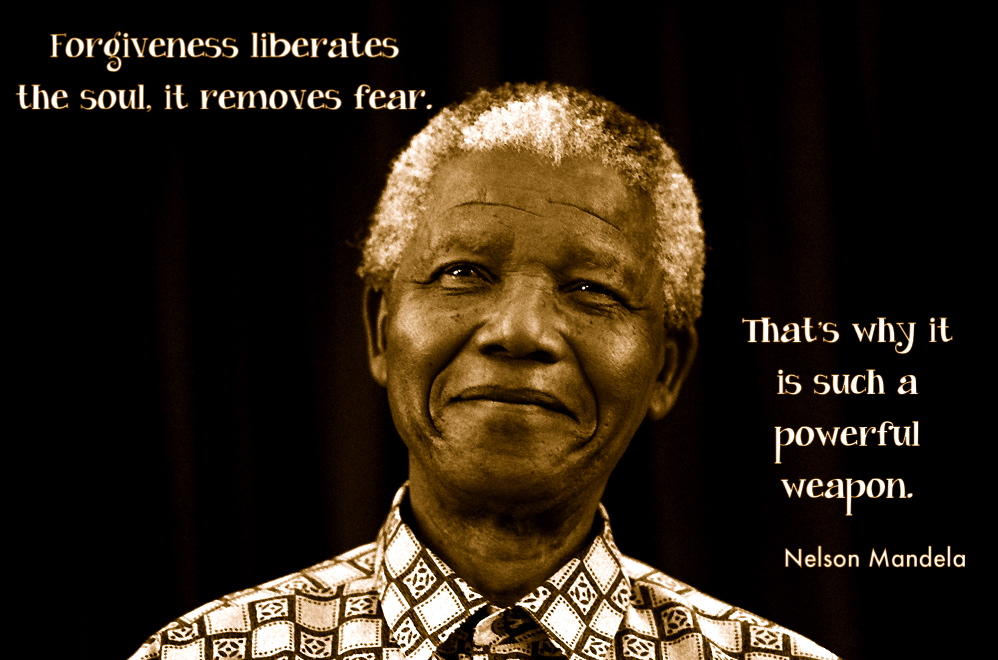
“In the end, reconciliation is a spiritual process, which requires more than just a legal framework. It has to happen in the hearts and minds of people.”

Nelson Mandela
Forgive
Forgiveness is a weapon
The Father of our Rainbow Nation said that reconciliation is a spiritual process and it is just that. The Father of all nations (the God of the Bible) says that we should reconcile with everybody. If we remember that someone has something against us, we should go and reconcile. He is not saying that I must go and reconcile if I have something against another – “So if you are about to offer your gift to God at the altar and there you remember that your brother has something against you, leave your gift there in front of the altar, go at once and make peace with your brother, and then come back and offer your gift to God.” (Matthew 5:23,24 – Good News Translation – GNBDK). Interesting that the verses after that talks about reconciling with your accuser when he takes you to court, otherwise you will pay the last cent!
So let me just turn to the churches and christians in South Africa. Let us forget politics for now. One of the functions of the church is to enable reconciliation in the country. It is not only there to enable it, but it is there to drive it, to motivate it and to mobilise its members to reconciliation. There are two parties to the process. To a large extent both parties are angry. There is anger because of apartheid and the legacy of apartheid. There is anger because of AA and BEE and the legacy of that. Contrary to what the Bible teaches, the young upcoming next generation is still punished. The punishment is on all sides of the colour spectrum.
Let me take the following example of reconciliation. You have a truck that you use in your building projects. You have a government contract and you are making a good living out of it. I ask you and you lend your truck to me on a particular Saturday as I want to get some sand on my property and it is much cheaper if I do it myself. I use your truck, but a crazy driver hits me in the borrowed truck as he is running a red light. There is damage of more than R150 000 to your truck. I am innocent, but I am responsible as I was using your truck. I come back to you and  I apologise. You accept my apology. However, you cannot work with your truck on Monday morning because of the accident. You lose money in the process. You will recover your losses from the guilty party (the other driver).
The situation of course is different if I am guilty of the offence. If I did not stop at the red light and I caused the damage, then I am responsible and guilty. Now it is not enough to apologise. Now it is also a requirement for me to ask for forgiveness. When I have asked forgiveness and you have granted it, you do not have a claim of the R150 000 (or the subsequent loss) anymore on a spiritual level. (Extending forgiveness means that you release the claim that you have against me – you release the right that you have to enforce justice).  At the same time I , however, have the love obligation to settle the damages and to put you in the same position as you were on the Friday afternoon before I borrowed your truck.
Reconciliation
Reconciliation crticical
So in South Africa we need to ask and extend forgiveness as christians. We cannot get reconciliation before we do that. We cannot get reconciliation if we do not hear the stories of ordinary people, of ordinary christians. We still live apart in our worlds almost two decades after apartheid was dismantled legally. We cannot expect the politicians to lift BBE and AA until we have demonstrated aptly that we are putting everything to work to reconcile and make restitution. Making restitution is so much more than what BEE or AA could achieve.
There is an enormous emotional relief when we ask for forgiveness and embark on the process of restitution. There is also enormous relief when we grant forgiveness and work together as brothers and sisters. There is much hatred or bitterness around in South Africa. There is much love and forgiveness needed. Love is action and not a feeling. If you do not act, you do not love. If you do not love, you are not a christian. If your church does not advocate this forgiveness and reconciliation and active love, then in the words of Sir Richard Branson, “Screw it, let’s do it”.
Let us go beyond AA and BEE. Let us go the route of Biblical love. Let us build South Africa. Let us reconcile!
19 March 2017

together

Share this:

  • Print (Opens in new window) Print
  • Share on Pocket (Opens in new window) Pocket
  • Share on Facebook (Opens in new window) Facebook
  • Share on WhatsApp (Opens in new window) WhatsApp
  • Share on Telegram (Opens in new window) Telegram
  • Share on LinkedIn (Opens in new window) LinkedIn
  • More
  • Share on Tumblr (Opens in new window) Tumblr
  • Share on X (Opens in new window) X
  • Share on Pinterest (Opens in new window) Pinterest
  • Email a link to a friend (Opens in new window) Email

Filed Under: christianity, community, politics Tagged With: ACDP, ANC, Anglican, christian, church, DR Church, EFF, Ethiopian Church, FF+, free church, Gereformeerde Kerk, Hansie, Hansie Louw, Hervormde Kerk, Jacob Zuma, jew, Julius Malema, Kenneth Meshoe, kerk, liefde, love, Mandela, marathon, muslim, Ned Geref Kerk, NG Kerk, ongekerk, Presbyterian Church, restitution, Roman Catholic, running, Skosana, voting, Xola

Calendar

March 2026
M T W T F S S
 1
2345678
9101112131415
16171819202122
23242526272829
3031  
« Aug